

Ask a question and a tidy, confident answer appears. In those few seconds, a very fast research assistant reads a pile of pages, decides which ones to trust, and writes a summary. Understanding that journey is the heart of generative engine optimization, because every stop is a place where a business can be found, skipped, or misunderstood.
What Is Generative Engine Optimization? The 60-Second Version
If you are asking what is generative engine optimization, here is the short answer: it is the practice of making your business easy for AI tools to find, understand, and describe correctly. Think of it as helping the research assistant do its job well.
The Journey of One Question
Here is the route one question takes.
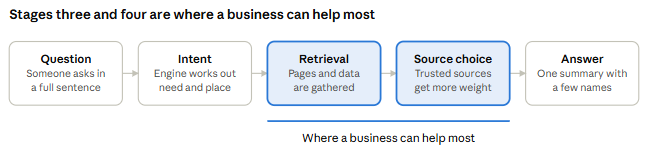
The question and the final writing are out of a business’s hands. The middle is where it earns its place.
Step One: The Engine Reads Between the Lines
People rarely type keywords anymore. They type “a plumber who can come tonight near the stadium,” and the engine unpacks the need, the place, and the timing.
Step Two: AI Search Optimization Begins at the Fetch
Next, the engine gathers material. Some tools search the live web, others lean on what they already know, and many do both. Solid AI search optimization means pages that are easy to reach, easy to read, and clear about what they offer.
Step Three: Local Visibility in AI Search Comes From Nearby Signals
For place-based questions, the engine looks for signals that tie a business to a location: consistent listings, reviews that mention neighborhoods, and clear service areas. Building local visibility in AI search is mostly about making those signals agree.
Step Four: Your Brand in AI Search Answers Depends on Trust
Now the engine chooses whom to believe. Plain facts that match other sources tend to carry more weight. That is how a brand in AI search answers earns or loses its spot.
Step Five: LLM Search Optimization Keeps the Summary Accurate
Finally, the engine writes. It paraphrases, so vague or contradictory source material can produce a muddled summary. LLM search optimization reduces the risk by giving the model short, specific, quotable statements to work with.
Is ChatGPT Recommending Your Brand? Test the Whole Journey
Try it yourself: is ChatGPT recommending your brand? Ask a few AI tools the questions your customers ask, in natural language and with a location. Save the answers, and note which stage seems to fail: no mention, wrong details, or a competitor named first.
AI Brand Visibility Is the Sum of Every Step
Strong AI brand visibility is not one trick. It is the sum of small wins at each stop.
GEO Strategies for AI Visibility, Stop by Stop
Here is how GEO strategies for AI visibility map to the journey:
- Understanding: write pages around full questions customers ask
- Fetching: keep pages crawlable, current, and fast
- Locating: align listings, reviews, and service areas
- Trusting: back claims with proof and outside mentions
- Summarizing: use short, specific sentences
AI Visibility Solutions and GEO Strategies to Build AI Visibility
When the test shows a problem, start with practical AI visibility solutions: correct the facts at the source, then recheck. Over time, steady GEO strategies to build AI visibility keep the pages, listings, and mentions fresh so the engine keeps finding the same story.
When a Generative Engine Optimization Service Helps
If the journey has several weak stops and the team is small, a generative engine optimization service can audit each one, prioritize fixes, and monitor results. The goal is simple: when the web comes to your customer, your business is part of what arrives.
Frequently Asked Questions
How do generative engines find information?
Many AI tools combine what they learned in training with live searches of the web. They gather relevant pages, weigh the sources, and write a summary. Exact methods vary by tool.
Do generative engines read my website?
They can, when a page is accessible and relevant to the question. Pages that are slow, blocked, or unclear are less likely to be used.
Why does AI sometimes get facts wrong?
Models paraphrase, and conflicting or outdated sources can confuse them. Consistent, current facts across a website and listings reduce the risk.
Does location matter in AI answers?
Often. For nearby needs, engines look for signals that tie a business to a place, such as consistent listings, reviews, and clear service areas.
Where should I start fixing things?
Start with accuracy: correct the facts on your website and listings. Every later stage of the journey depends on them.